Dutch Bucket / Bato bucket About
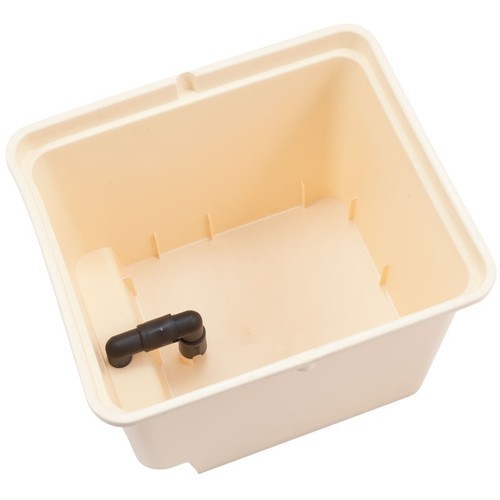
A Dutch bucket, the Bato bucket is perhaps the most commonly used container for holding plants in a hydrponic growing system. Bato buckets can be connected easily, allowing hydroponic systems to be scaled to virtually any size needed.At first glance, the Bato bucket looks like nothing more than a square conventional planter. However, appearances are deceptive. These buckets are used for both hydroponics and aquaponics, and feature the ability to use a single watering line and a single drainage line for multiple media beds when lined up together.
Hydroponics rely on the use of growing mediums to ensure that plants have a place to anchor, and benefit from stability. While larger media beds can be used, they are not always ideal. The Bato bucket system provides a solution that offers scalability, combined with a small form factor.
While Bato buckets can be used to grow virtually any plant type, they are especially useful for vining crops like tomatoes and cucumbers, as well as for growing larger plants. Its also interesting to note that vining plants can be trained upward, as well as horizontally, to create living walls of plants that are easy to monitor and, after fruiting, easy to harvest.
Unlike other hydroponic systems, each Bato bucket acts as both a host for a media bed, as well as the water and nutrient solution required for plant growth. The buckets are connected in series, and use the same water line, and the same drainage line. They can be set either on a bench or table, or directly on the floor if necessary.
When connected in series, they should be staggered, with each alternating buckets drain port facing inward to ensure that a central drain line can serve all buckets in the series.
Additional Information:
- Port of Dispatch: Nhava Shiva
Versatile Application for Diverse CropsDesigned for hydroponic growers, the Dutch Bucket system is compatible with a range of vine cropsincluding tomatoes, cucumbers, peppers, and eggplants. Whether operating in open fields or greenhouses, scalable installation ensures optimal plant spacing and maximum productivity.
Durable, Reusable, and Weather-ResistantManufactured from high-grade, UV-treated polypropylene, these buckets withstand extreme temperatures (-20C to +60C) and resist sunlight degradation. The smooth, non-toxic surface allows for effortless cleaning, making them ideal for repeated use over numerous growing cycles.
Easy Maintenance and Modular ExpansionFeaturing a sloped floor, side outlet, and grommeted drainage points, the Dutch Bucket streamlines nutrient solution recirculation and overflow prevention. Its modular, stackable construction simplifies expansion, customization, and efficient crop coverage in a range of settings.
FAQs of Dutch Bucket / Bato bucket:
Q: How do I install the Dutch Bucket system in a greenhouse or open field?
A: Installation is straightforward: these buckets can be arranged on benches, racks, or directly on the ground. Connect the drainage outlets (1 or 2 holes) with provided grommets, and link to a drip irrigation setup. The modular design easily adapts to custom greenhouse or field layouts.
Q: What type of growing media can I use with these buckets?
A: The Dutch Bucket is suitable for coconut coir, perlite, expanded clay pebbles, or a combination, providing optimal support and drainage for a wide variety of hydroponic crops.
Q: When should the buckets be cleaned and reused?
A: It is recommended to clean the buckets thoroughly between each growing cycle. High-quality, non-toxic polypropylene with smooth surfaces ensures effortless cleaning for reuse, maintaining healthy growing conditions.
Q: Where can I use these buckets, and are they suitable for outdoor installations?
A: Their UV-resistant, weatherproof construction makes them perfect for both indoor greenhouses and outdoor cultivation, ensuring longevity despite prolonged exposure to sun or fluctuating temperatures.
Q: What is the process for nutrient solution drainage and recirculation?
A: A sloped bucket floor ensures complete drainage toward the side outlet. Use single or dual outlet holes with grommets to channel runoff, which can then be collected and recirculated as needed in a hydroponic system.
Q: How does the Dutch Bucket system benefit crop spacing and expansion?
A: Its modular, stackable design allows growers to efficiently organize plants, optimize available space, and easily expand coverage by adding extra buckets as required without complex modifications.









 Send Inquiry

 Send Inquiry